PEN eNews 5(3) November 2015
PEN eNews is a monthly e-newsletter shared with the global PEN Community and created to help dietitians position themselves as leaders in evidence-based nutrition practice. In addition, users of the PEN System will find articles on the new evidence, resources and features available and how to maximize one's use of PEN.
November 2015 · Volume 5, Issue 3

infographics: a picture may be worth a 1000 words
I am noticing an increasing number of infographics around health, food and nutrition online. Infographics are a way of communicating complex information into a palatable, easily consumable format through the use of images with little text (1-4). With information availability being akin to drinking from a fire hose, infographics may be a welcome change to sharing complex information. They are attention-grabbing, visual and easily shareable, and thus may offer some advantages over communicating the same information via text (4,5). A picture may just be worth a 1000 (or more) words.
Examples of infographics that have caught my attention:
|
Infographics and other forms of data visualization are part of the fields of health communications, epidemiology, public health (2,3) and knowledge translation (4). Research is underway to examine best practices, potential usefulness and impact of data visualization (2,4).
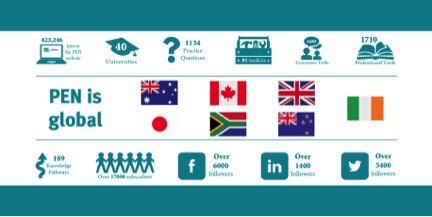
In this issue of PEN® eNews 5(3), we have articles sharing some exciting new developments in the PEN® knowledge database.
- Using GRADE to grade the evidence in PEN® outlines a system of grading research and our plans for incorporating GRADE.
- How do I…find timely information on hot topics on nutrition in PEN®? Will help you find the latest evidence-based responses to nutrition-related topics in the news.
- Insights into dietetics in the Land of Fire and Ice while on my summer vacation offers an insider’s look into dietetic practice in Iceland.
- International working party tackles the important and high-risk area of food allergy to update and expand the practice guidance in PEN® provides an update on practice guidance in the area of food allergy.
- What does an iceberg have to do with eating? Incorporating the cognitive-behavioural approach in your practice outlines an area of practice opportunity for dietitians.
- PENny the PENguin: Her story describes how the PEN® mascot came to become an international traveling sensation!
This and more in PEN eNews 5(3).
Kristyn Hall MSc, RD
Editor, PEN® eNews
References:
- Health Science Information Consortium of Toronto. Infographics. June 2, 2015. Available from: http://guides.hsict.library.utoronto.ca/content.php?pid=568839&sid=4690381#17272500
- Nybro E, Skolnik L. Data Visualization: A Tool for health communicators. October 2013. Available from: https://www.k4health.org/blog/post/data-visualization-tool-health-communicators
- Rosa S. Infographic development. Public Health Ontario. 2015. Available from: https://www.publichealthontario.ca/en/LearningAndDevelopment/Events/Pages/Infographics.aspx
- Crick K, Hartling L. Preferences of knowledge users for two formats of summarizing results from systematic reviews: infographics and critical appraisals. 2015 Oct 14. Available from: http://www.ncbi.nlm.nih.gov/pmc/articles/PMC4605679/
- Milovanovic D, Ivanisevic L. Infographic as a marketing communication tool. Symorg 2014. Available from: http://symorg.fon.bg.ac.rs/proceedings/papers/04%20-%20COMMUNICATION%20MANAGEMENT%20AND%20SOCIAL%20NETWORKING%20.pdf#page=23
PEN® eNews may contain links to other external websites. PENnutrition.com is not responsible for the privacy practices or the content of such external websites. Neither Dietitians of Canada, nor any dietetic associations contributing to or licensing the content in Practice-based Evidence in Nutrition: PEN® endorse the content, products or services on other websites.
What's New in PEN®
 and updated
  symbols in PEN to see more new and enhanced content!
 New Knowledge Pathways
New Practice Questions
Professional Tools
- Gastrointestinal System - Irritable Bowel Syndrome Background
- Food Safety - Arsenic in Rice Background
- Sample Vegetarian Meal Plan: Teenage Male (14-18 yr old)
- Sample Vegetarian Meal Plan: Child (4-8 year old)
- Carbohydrates and Health
- Evidence Clip: Butter, Margarine, Saturated and Trans Fats - Making Sense of Research Reported in the New
- Canadian Guidelines for the Diagnosis and Management of Fibromyalgia Syndrome
- EULAR Evidence-based Recommendations for the Management of Fibromyalgia Syndrome
- The Role of the Dietitian in the Built Environment
- Food Insecurity in Canada English French
- Policy and Procedure on Hydration
- Cardiovascular Disease - Hypertension: Prevention Toolkit
- Gout Toolkit
- Endocrine/Metabolic - Polycystic Ovary Syndrome (PCOS) Toolkit
- Growth Charts for Children with Down Syndrome (Updated)
Trending Topics
- WHO Report on Meat and Cancer; Soylent or Ambronite; Dysphagia Framework & Labels
- Evidence Clip: Butter, Margarine, Saturated and Trans Fats - Making Sense of Research Reported in the News
Client Tools
- Canadian Physical Activity Guidelines in Inuktitut and Inuinnaqtun
- Arthritis Information Sheet: Fibromyalgia
- DAA - Vegetarian Eating for Older Adults
- DAA - Vegetarian Teenagers
- DAA - A Guide to Vegetarian Eating
- DAA - Health Benefits of a Vegetarian Diet
- DAA - Protein and Vegetarian Diets
- DAA - A Guide to Vegan Eating
- Low FODMAP Diet Resources
- Dietitians Promote Health English French
- Fr: Directives en matière d'activité physique pour les populations spéciales (Physical Activity Guidelines for Adults with Spinal Cord Injury)
Updated Knowledge Pathways
- Musculoskeletal/Connective Tissue Disorders - Fibromyalgia
- Gastrointestinal System - Irritable Bowel Syndrome: FODMAP
- Cardiovascular Disease - Hypertension
Updated Practice Questions
- Are there any dietary supplements or nutrients that can help prevent or treat cold sores (herpes labialis caused by herpes simplex virus 1, HSV-1) in adults prone to frequently recurring HSV infections?
- Are there taste differences between organic and conventionally farmed produce?
- Does organic food consumption reduce pesticide metabolites in children?
- Are there differences in microbiological concerns or antibiotic resistance between organically and conventionally farmed meats, poultry and milk?
- Are there differences in microbiological food safety concerns or heavy metal contamination between organic and conventionally farmed produce and grains?
- Are the biological pesticides used on organic food safe?
- What fluid and electrolyte restrictions are required in adults treated with hemodialysis therapy (i.e. phosphorus, calcium, sodium, potassium, fluid)?
- What are the effective nutrition counselling methods or tools for managing hyperphosphatemia in individuals with chronic kidney disease (CKD)?
- Is the consumption of rice (white and brown) associated with increased arsenic-related health risks?
- What are the short- and long-term physical and mental health effects of high added sugar consumption in children and adolescents (≤19 years old)?
How Do I … find timely information in PEN® on trending nutrition-related topics?
Kerri Staden BSc, RD Dietitians of Canada
PEN® Resource Managers
Do you want to access the latest evidence-based responses to nutrition-related topics in the news? Visit Trending Topics in the PEN® knowledge database! This past June, the ‘News-making Evidence’ section was renamed Trending Topics. This new name, Trending Topics, provides a more accurate description of the type of content you will find within this section of PEN. Our aim with Trending Topics is to help provide credible and evidence-based responses to “hot topics” in the news.
Dietitians from around the world receive questions about nutrition from consumers, clients, other health professionals and the media. As busy practitioners, it can be very challenging to keep up with knowing what is in the news and what is credible. To help you, we regularly scan the media for nutrition-related topics and posts, such as:
- timely single Article Analyses,
- links to evidence-based reviews,
- select media releases from our global dietetic association partners, and
- more detailed topic overviews such as Evidence Clips.

Jayne Thirsk* RD, PhD, FDC
Director PEN®: Practice-based Evidence in Nutrition®
Dietitians of Canada
Using GRADE to grade the evidence in
PEN®
knowledge database
GRADE is an acronym for:
Grading of Recommendations Assessment Development Evaluation and it has been endorsed or is being adopted by guideline groups, organizations etc. all over the world. The GRADE approach is guided by leaders in evidence-based medicine with a desire to create a common evidence grading system that is credible, reproducible and understandable by guideline users everywhere.
Early in September, the PEN® GRADE working group met in Toronto, Ontario to begin intensive training to transform how the evidence is graded to make practice recommendations for the PEN database. PEN will join over 75 prestigious organisations such as the WHO, the Cochrane Collaboration, National Institute of Clinical Excellence (NICE) in using the GRADE system.
We were fortunate to receive our education from Dr Nancy Santesso (RD, MLIS, PhD) from the McMaster GRADE training centre. Over 4 full days we learned about the GRADE techniques and began to develop what will be the PEN GRADE process. The fact that she began her career as a dietitian meant that she was able to provide illustrative examples to us in “dietetic language” using nutrition evidence examples.
GRADE guidelines are transparent in terms of the processes used to find and evaluate the evidence and they focus on outcomes.
GRADE recommends standards for how to:
- identify the practice questions and outcomes of interest
- use evidence that has been systematically gathered and synthesized
- assess and summarize the evidence for each outcome
- summarize and use the evidence for other factors important to decision making (patient values and preferences, resources, acceptability, equity, feasibility etc.)
- make a recommendation noting the strength of the recommendation and the quality of evidence upon which it is based.
Recommendations for preventing fracture in long-term care.
Remarks
“The recommendation for residents at high risk places a high value on the reduction in hip fractures and the small reductions in vertebral and non-vertebral fractures and in mortality that can be achieved with calcium supplementation. It places a lower value on the small increased risk of gastrointestinal adverse effects that may occur and the resources required in long-term care to provide calcium supplementation.”
“These recommendations apply to supplementation with any calcium compound, including calcium carbonate or citrate. The recommendation to limit supplementation to 500 mg was based on the uncertainty about harms of calcium supplementation in studies of community-dwelling individuals who received calcium supplementation of 1000 mg or more daily. The benefits of calcium supplementation are closely linked to adequate vitamin D intake.”(1)
1. Papaioannou A, Santesso N, Morin S, Feldman S, Adachi J, Crilly R et al. Recommendations for preventing fracture in long-term care. CMAJ. 2015 Sept 14. http://www.ncbi.nlm.nih.gov/pubmed/26370055 OR http://www.cmaj.ca/content/early/2015/09/14/cmaj.141331
Transitioning PEN to using GRADE
Using GRADE will make the key practice points in PEN easier to interpret and quicker to read. PEN has always given dietitians an assessment of the strength of the evidence, moving to a system that is widely recognized by other health professionals will make it easier for dietitians to communicate benefits of treatment to the wider multi-disciplinary team.Many of our current PEN processes are in line with the GRADE approach while others will need to be enhanced or made more explicit. GRADE does not simply focus on RCT data, rather it encourages incorporation of many types of studies and information related to patient preferences, equity, feasibility etc. to inform decisions. PEN is a respected source of information for dietitians around the world, gradually incorporating GRADE into PEN’s systems and processes will enable it to maintain and strengthen its influence.
The PEN international collaboration is about more than simply synthesizing the evidence for busy dietetic practitioners. A key objective of the collaborative partnership is to build capacity for dietitians to be not only knowledgeable users of evidence but also skilled contributors to the creation of evidence-based practice recommendations. The PEN team will work closely with the MacGRADE training centre at McMaster University to create a series of short videos/modules to help dietitians understand and use GRADE … whether they are looking at PEN® evidence or guidelines created by other authoritative sources.
Leaders share their enthusiasm for transitioning PEN® to using GRADE:
“The PEN Collaboration is committed to providing-practice based evidence in nutrition, and now to incorporating GRADE. I’m sure it is why PEN has been and will continue to be an invaluable resource to dietitians!” Dr Nancy Santesso, MacGRADE training Centre“Using GRADE will help dietitians to present evidence for their practice in a way that is understood by colleagues across the world.” Dr Judy Lawrence, BDA
“Using an internationally recognised system such as GRADE to evaluate the quality of evidence and strength of recommendations for practice based questions allows PEN to clearly communicate evidence related to our profession to dietitians and other health professions.” Dr Judy Bauer DAA
Watch for more information about our plans to transition PEN to GRADE in future PEN eNews issues.
* On behalf of the PEN GRADE Working Group:
 Heather Alaverdy
Beth Armour
Judy Bauer
Jane Bellman
Tanis Fenton
Catherine Freeze
Judy Lawrence
Heather Petrie
Dawna Royall
Mary Anne Smith
Kerri Staden
Jayne Thirsk
Missing from the photograph – Catherine Freeze, Heather Alaverdy and Kerri Staden
Insights into Dietetics in the Land of Fire and Ice while on my summer vacation!
This summer I had the wonderful opportunity to make a stopover in Iceland on my way to the PEN® Global meetings in Birmingham,
 England. I quickly scanned the International Confederation of Dietetic Associations (ICDA) website, learned that Fríða Rún Þórðardóttir was the Icelandic representative to ICDA, and sent her an email about possibly meeting with her to learn about dietetic practice in Iceland. She was quick to agree and we made arrangements to meet at the Landspitali University Hospital in Reykjavik where she manages the clinical dietetic part of the food service department.
Fríða Rún completed her undergraduate and Masters dietetics degree and internship in the USA at the University of Georgia as a scholarship athlete. When she isn’t managing at Landspitali, she consults on sports nutrition in Reykjavik.
Foodservice at the Landspitali University Hospital
Landspitali foodservice prepares and serves up to 5000 meals on a typical weekday! This can include up to 30 different specialty menus as well as meals served in 10 dining halls and up to 30 different locations in the hospital and surrounding community. 
Environmental sustainability incorporated into food service department:
With the growing international interest in environmentally sustainable food systems, I was intrigued by the “green swan” labels noticeable on many of the products in the food service department. The Ecolabelling can be applied to products and services and the Landspitali food service department received the certification in March this year.
The Nordic Ecolabel is a voluntary system that guides the department in choosing environmentally friendly products and make decisions that are more sustainable ecologically. It involves meeting standards for things like waste disposal, energy conservation, use of local foods, avoidance of GMO-containing foods and those made from species that are considered endangered.
Integration of clinical dietetics and nutrition research:
Fríða Rún also arranged for me to meet with the clinical dietitians at Landspitali. Imagine my surprise to meet Svava Engilbertsdóttir senior dietitian and learn that she obtained her dietetics training in Winnipeg, Manitoba, Canada! We walked over to the offices that house the Department of Clinical Nutrition, the University of Iceland’s Faculty of Food Science and Nutrition and the Unit for Nutrition Research. The integration of clinical dietetics and nutrition research was inspiring. Professors, associate professors and other faculty members are involved in the clinical care, conduct research and teach and mentor students.
While there, I met Ingibjorg Gunnarsdóttir, Professor and Director of the Department of Clinical Nutrition and the Unit for Nutrition Research. She oversees the 14 clinical nutrition staff and among her many research interests, Ingibjorg contributed to the Nordic Nutrition Recommendations (NNRs), which we were delighted to be given permission to add to the International Dietary Guideline Collection in PEN®.
Dietetic training in Iceland is going local:
Up until recently, all dietitians working in Iceland received their training abroad. That will soon change with the launch of the first  dietetic internship this fall. Two students will attain their clinical and research competencies and will graduate with a Masters degree and internship.
It was a privilege for me to visit with colleagues at this dynamic university facility. I hope that the future brings more visits and possible opportunities to collaborate on research or training endeavours.
Written by
Jayne Thirsk RD, PhD, FDC
Director of PEN®
Dietitians of Canada
jayne.thirsk@dietitians.ca
“A knowledgeable and competent dietitian is an integral part of the food allergy multidisciplinary team, contributing to effective diagnosis and management of food allergic disorders.” (1)
working party tackles high-risk area of food allergy
Leadership for the updating of existing questions or creation of new questions came largely from a skilled group of practitioners and researchers from the United Kingdom:
Kate Grimshaw 
Isabel Skypala
Rosan Meyer
Carina Venter
DAA: Kathy Beck, Elesa Crowley, Vicki McWilliam, Corinna Michael, Gail Scarlett
DC: Becky Blair, Rita Barbieri, Linda Kirste, Christine Mehling, Liz Yeung
BDA: Ann Marie Frohock
PEN Evidence Analyst Dawna Royall provided mentorship to the new authors and coordinated this large and complicated task across multiple international time zones.
The process of updating this content was both exhilarating and challenging. We developed new collaborative relationships and identified improved processes for managing updates and reviewing PEN content.
To date 19 questions have been updated with 4 questions still in progress and several more new questions being considered.
| Nineteen questions from the following knowledge pathways have been updated: |
Thanks to all the skilled dietitians who contributed to this extensive update. We learned a lot, not only about how to prevent and or manage food allergies, but also about how to work effectively together internationally to enhance dietetic practice.
- Maslin K, Meyer R, Reeves L, Mackenzie H, Swain A, Stuart-Smith W et al. Food allergy competencies of dietitians in the United Kingdom, Australia and United States of America. Clin Transl Allergy. 2014 Nov 14;4:37. Available from: www.ncbi.nlm.nih.gov/pubmed/25905007
Submitted by:
Jayne Thirsk RD, PhD, FDC
Director of PEN®
Dietitians of Canada
jayne.thirsk@dietitians.ca
PENny the PENguin: Her story


Delegates visited the PEN stand in the trade exhibit to learn about PEN, and as a bonus took home a PEN penguin. After the success of the give-aways at the conference, the penguin went global! Firstly DAA CEO Claire Hewat, PEN Research Translational Leader Judy Bauer and DAA President Liz Kellett took a supply of penguins to the Asian Congress of Dietetics in Taipei, Taiwan in August 2014.
From there the penguin travelled to different parts of the globe with delegates, and the nickname ‘PENny the PENguin’ began.


Since then PENny has also been to:
- Cape Town, Durban and Johannesburg in South Africa with DAA to welcome ADSA
- Perth, Western Australia at the 33rd DAA National Conference in May this year
- Quebec City, Canada at the Dietitians of Canada National Conference in June this year
- Plus a number other cities and countries with her dietitian companions.

It now seems there is a PENny obsession which has been formed in our international community of dietitians, with PENny photos on social media of her visiting many corners of the world (with her dietitian companions).
PENny is like a metaphor for PEN – reaching all parts of the globe too!
Written by:
Emma Jones APD
Judy Bauer APD, PhD, FDAA
Sara Grafenauer AdvAPD, PhD
Dietitians Association of Australia
What does an iceberg have to do with eating?
Incorporating the cognitive-behavioural approach in your practice: Part I.
Do you have clients that say, “I know what to do, but I just can’t seem to do it!” You have likely presented the recommended eating guidelines for their condition, used motivational interviewing techniques to assess their personal priorities, assisted them to set SMART goals, discussed relapse prevention, and yet they still struggle. What’s missing? What else can you and the client do? The answer may be to help the client understand their thinking habits in order to understand and change their eating habits.

Stay tuned for the next article in this two-part series that will provide more practical tips for incorporating the cognitive-behavioural approach into your practice.
Note: Clinical practice guidelines for nations around the world recommend the use of cognitive-behavioural interventions for those living with obesity/overweight and chronic medical conditions such as diabetes.
Written by:
Wendy Shah, RD and Dr. Colleen Cannon, PhD, RPsych
Owners and operators of Craving Change
www.CravingChange.ca
CravingChange™ is a PEN® reviewed tool and resource available in the PEN® knowledge database.
PENny greets dietitians of Europe at the EFAD Conference
Attending the 9th Annual EFAD Conference in Amsterdam turned out to be a fantastic way to spread awareness of the PEN® knowledge database amongst dietitians in Europe.| EFAD (European Federation of the Associations of Dietitians) was established in 1978 in Copenhagen, Denmark with the aim to promote the development of the dietetic profession and facilitate communication between National Dietetic Associations and other professional, educational or governmental organisations. In October 2015, EFAD had 34 National Dietetic Association members, representing over 35,000 dietitians in 27 European countries. |
The PEN stand was busy and bustling, and provided a number of how-to resources for EFAD delegates to take away. The promotional materials including pens, post-it notes and PENny penguins were also very popular! Overall, there was a high level of engagement and curiosity about the PEN knowledge database amongst EFAD dietitians including questions such as:
- how is the evidence reviewed and what is the process?
- How often are the evidence and resources in the PEN® knowledge database updated?
- Does the PEN knowledge database include national guidelines for individual countries?

It was also useful to be able to rectify the misconceptions and misunderstandings regarding the PEN knowledge database. For example, some thought "PEN" was the same as PubMed or a library containing all research papers relating to nutrition and dietetics. It was worthwhile having the opportunity to explain how the PEN knowledge database not only helps dietitians understand the evidence-base, but also helps to apply that evidence-base to practice.
Written by Sammie Gill, Policy Officer (Evidence-based Practice).
BSc (Hons), PGDip, R.SEN, RD.
British Dietetic Association.
Join the PEN® Community. Sign up for PEN® eNews, like us on Facebook, follow us on Twitter and connect with us in LinkedIn with the appropriate links?
Contact Us


To access current and archived copies of PEN® eNews, go to:
http://www.pennutrition.com/enews
Do you have comments, questions or feedback? Please contact us:
Jayne Thirsk RD, PhD, FDC
Director of PEN®
Dietitians of Canada
jayne.thirsk@dietitians.ca
Sue Kellie MSc
Deputy Chief Executive
British Dietetic Association
globalpen@bda.uk.com
Natalie Stapleton APD, AEP
Practice and Credentialing Dietitian
Dietitians Association of Australia
practicesuppport@daa.asn.au
Kristyn Hall RD, MSc
Editor of PEN® eNews
Dietitians of Canada
eNews@pennutrition.com
 November 2015 ·
Volume 5
(3)
November 2015 ·
Volume 5
(3)
A Publication of the PEN System Global Partners,
a collaborative partnership between International Dietetic Associations.
Copyright Dietitians of Canada. All Rights Reserved.