PEN® eNews 15(9) September 2025 - Happy Birthday, PEN System!
PEN eNews is a monthly e-newsletter shared with the global PEN Community and created to help dietitians position themselves as leaders in evidence-based nutrition practice. In addition, users of the PEN System will find articles on the new evidence, resources and features available and how to maximize one's use of PEN.
September 2025 · Volume 15, Issue 9
Reflecting on 20 Years of Practice-Based Evidence in Nutrition (PEN)
As two of the original architects that developed and launched Practice-based Evidence in Nutrition® (PEN) in 2005, we are honoured to reflect on its evolution and value two decades later.
The PEN System was created in response to findings from environmental scans and key informant interviews. Analyses revealed a pressing need among dietitians for support to navigate the overwhelming volume of nutrition information and to identify high-quality evidence to underpin professional advice.
Since its inception, the PEN System has proven to be a trusted source of evidence-based guidance, continually incorporating the latest research pertinent to practical nutrition-related questions. It is one of the innovative tools that has enabled Dietitians of Canada to elevate the role of dietitians as leading credible nutrition experts.
The information environment has shifted dramatically since the PEN System was initiated. We are now witness to a rise in anti-science and anti-expert sentiment. Pseudoscientific beliefs and conspiratorial thinking are gaining traction. They often challenge or replace scientific consensus, negatively impact public policy and undermine even well-established scientific institutions.
Experts now warn of the growing presence of AI-generated misinformation—so-called “junk science”—flooding social media and online health platforms. This phenomenon represents a strategic manipulation of the public knowledge base. Whereas clients once presented with questionable information sourced from the internet when consulting dietitians, they now offer content from tools like ChatGPT. These materials often lack context or require nuanced interpretation.
In this new landscape, it is more important than ever for dietitians in all practice settings to actively counter misinformation across digital platforms. As the PEN System marks its 20th anniversary, it remains committed to evolving alongside emerging technologies to support dietetic practitioners with rigorously curated, unbiased evidence reviews.

The 20-Year Evolution of Cardiovascular Disease in the PEN System
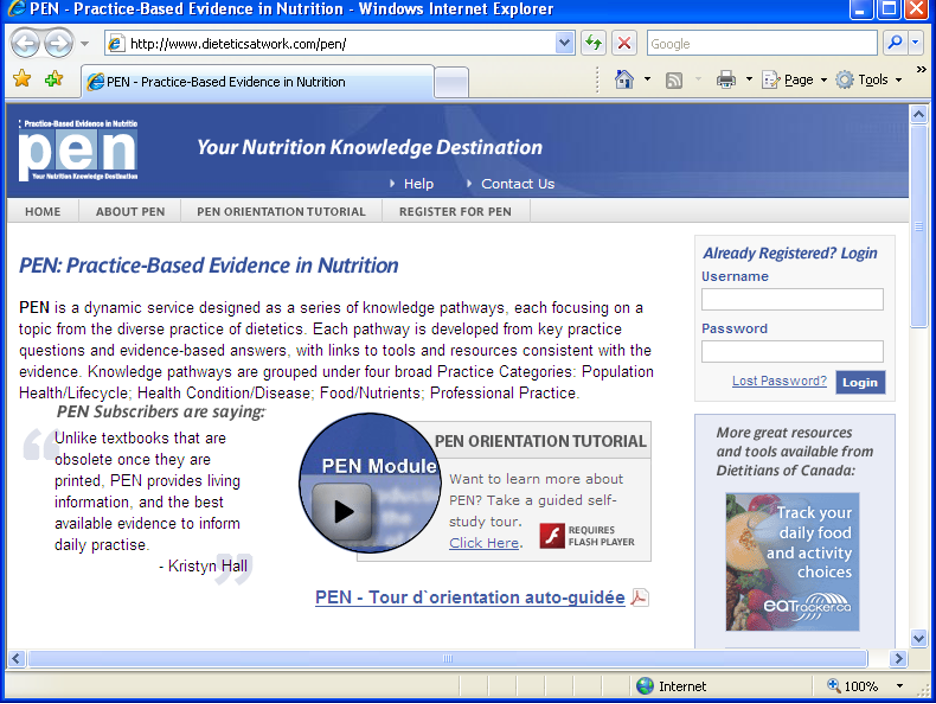
20 years ago, as a PEN evidence analyst, I developed the first ‘cardiovascular disease’ (CVD) knowledge pathway – what has changed since that time? A current search in the PEN Ssystem shows five CVD knowledge pathways and 73 practice questions! While some of the current content includes recommendations for individual nutrients, there is a reduced emphasis on restricting dietary cholesterol and saturated fat and new evidence that supports replacement with unsaturated fats. There has also been a shift towards the importance of overall dietary patterns with recommendations for Mediterranean-style, DASH, portfolio and plant-based patterns to support heart health benefits.
With the introduction of GRADE (Grading of Recommendations, Assessment, Development and Evaluation) process, several of the questions now provide PEN GRADE Recommendations that report the certainty of evidence for ‘patient important outcomes’ and the strength of the recommendation by considering the balance of benefits and harms and patient values. For example, the conditional recommendation for not taking vitamin D or calcium supplements for CVD prevention or treatment is based on moderate quality evidence that showed no reduction in CVD events and extra costs to the individual to purchase these supplements.
Overall, it has been an exciting evolution to develop and update content in the PEN database as new evidence emerges that impacts dietetic practice.
Here are the PEN CVD Knowledge Pathways:
Dawna Royall, MSc, RD, FDC
PEN Senior Evidence Analyst
 September 2025 ·
Volume 15
(9)
September 2025 ·
Volume 15
(9)
A Publication of the PEN System Global Partners,
a collaborative partnership between International Dietetic Associations.
Copyright Dietitians of Canada. All Rights Reserved.